Plastic Pallets Designed for the Chemical Industry
Our plastic pallets are engineered to meet the specific demands of the chemical industry.
Robust Solutions for the Chemical Industry
At GT+plastics, we understand the need for safe and efficient logistics solutions when handling chemicals.
Our plastic pallets withstand challenging conditions, ensuring the protection of hazardous and high-value products.
Impact of the Chemical Industry on the Market
With stringent safety and quality standards, the chemical industry demands specialized logistics solutions for handling sensitive and hazardous materials. GT+plastics pallets offer a reliable, purpose-built choice to address the sector's unique challenges.
Key Requirements in the Sector
Corrosion resistance
Adaptability to harsh environments
Secure and reliable product handling
Ability to support heavy loads
Differentiators of Our Plastic Pallets
Our competitive advantages include:
-
High Load Capacity
Ideal for supporting heavy products and large volumes.
-
Easy to Clean
Our pallets can be easily disinfected, reducing contamination risk.
-
Chemical Resistance
Made to withstand corrosive substances, ensuring safe handling.
-
Sustainable
Made with recycled materials, supporting a more environmentally friendly operation.
Recommendations for the Sector
We understand that each industry faces unique challenges. At GT+plastics, we offer customized plastic solutions tailored to meet each sector's specific needs.
TA-01
(40" X 48")
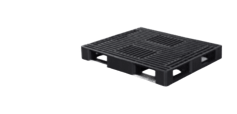
TA-07
(48" X 40")
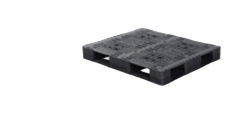
TA-08
(48" X 40")
TA-200
(40" X 48")
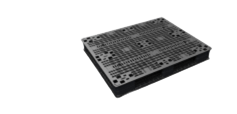
What the chemical industry requires from a pallet
HDPE resists moisture and many chemical agents, does not absorb water or oil and does not rust. Even so, compatibility is validated against each substance, concentration, temperature and exposure time; your product's safety data sheet is the starting point.
A closed deck keeps liquid from passing through the pallet, but it has no perimeter rim and does not hold volume. When the process requires spill containment, the answer is a containment system, not a pallet.
Chemical loads are often dense and stored at height. The TA-07, which GT+plastics recommends for this sector, carries 800 kg (1,764 lb) in racks; the TA-20 Reinforced family reaches 1,500 kg (3,307 lb) per position.
Bagged resins, pigments or fertilizers do not form a stable stack on their own. A double-sided pallet such as the TA-08 gives them continuous support on both faces.
Which pallet fits your chemical operation
These routes complement the models recommended above, based on load type and storage method.
I move drums, pails or carboys with pallet jacks and forklifts, racking up to 800 kg
I handle bags or bulk bags with forklifts
I need more than 800 kg per rack position
My product may drip and I do not use racks
I export and the pallet does not come back
Frequently asked questions
HDPE resists many chemical agents, but not all of them under every condition. Share the substance, concentration, temperature and exposure time with us so we can validate the model.
No. It keeps liquid from passing through the pallet, but it does not hold volume. If your process requires containment, you need a system designed for it.
Wood absorbs liquids and can become saturated; HDPE does not absorb water or oil, does not rust and is easy to clean, which helps prevent contamination between lots.
The double-sided TA-08 with an open deck: when stacked, the base of the bag settles between the slots. It is forklift-only and rated up to 1,000 kg in selective racks with a uniform load; for bags, ask us for the applicable working capacity.
No. ISPM 15 applies to wood packaging. Hazardous materials transportation rules still apply to your product, regardless of the pallet.
Contact Us for a Custom Solution
Request more information about our pallets for your business.
Leave us your details, and we will provide you with all the information.
Download the Catalog
Share your email address with us, and we will send you our product catalog.